HARRIS HOUSE FINE ART
Traditional Printmaking Methods
Relief, Intaglio, Planograph,
Serigraph, Collograph & Monotype
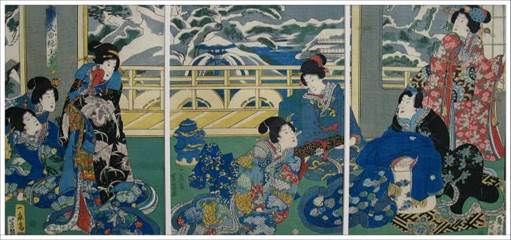
“Snow Days” Woodblock by Utagawa
Yoshiiku
Relief Printing Methods
Woodcut techniques
were used as early as the 5th century in
Around the middle of the sixteenth century the woodcut
began to fall out of favour as artists explored, then preferred, other more
exacting graphic techniques. Thanks largely to early twentieth century
expressionists— who found the technique perfectly suited to their needs—the
woodcut once again prevailed.
To create a woodcut print, the artist sketches an
image on a soft wood plank, then chisels away—along the grain of the wood—
those parts of the design which are not to be printed. The resulting surface of
the design, or relief, is then inked, covered with a sheet of paper, and
pressed, creating the woodcut print.
Wood Engraving, a variation of the woodcut was invented in the late
eighteenth century, the difference being that the design is created on the end
grain of the wood rather than the flat face. Using a harder wood, such as
boxwood, a graver or burin is used to create much finer lines than is possible
with woodcut. Due to the thin, strong blocks the wood engraving can be printed
with high pressure and was once used worldwide as a method of illustrating
books and periodicals. By the early twentieth century, as with woodcut, wood
engraving re-emerged as a favoured medium of artistic expression.
Linocut,
invented in the twentieth century, is created in the same manner as a
woodcut. Being soft and without grain, it is easier to cut in any direction,
thus greater detail may be achieved. Many modern masters—notably Picasso—favoured
this medium.
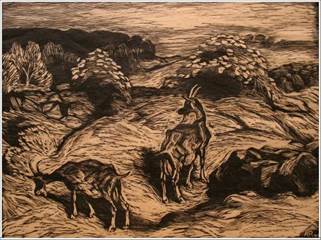
“Goats in
Swedish Landscape”
Woodcut by Aage Roose
Intaglio Printing Methods
The first etching on record was done by
To create an etching, a metal (often copper) plate is
covered with an acid-resistant substance (etching ground or varnish—hard ground) and then a design is drawn with a needle or other
sharp tool. The plate is then bathed in acid, which attacks only the exposed
lines. The longer the plate is exposed to the acid, the coarser the lines.
After removing the ground, the plate is inked and its surface wiped clean, then
covered with damp paper and passed under a cylindrical press. The ink captured
in the etched lines is then transferred to the paper, resulting in an etching.
When creating a soft ground etching, a special acid resistant substance is applied to the
plate into which different materials or objects can be pressed. The amount of
pressure applied results in how much soft ground is lifted from the plate. The
more that is removed the more exposed the plate will be to the acid bath and
vice versa. This technique allows unlimited possibilities for the creation of
tonal range and texture.
To create an aquatint, the artist uses a
porous ground or series of ground such as sand or resin, instead of covering
the plate with hard ground. This allows for the creation of granular and tonal
effects on the plate when exposed to the acid, and is often used in combination
with etching for its richness of tone. Goya is considered the greatest master
of this technique.
Drypoint is another method often used in conjunction with
etching. In this method, lines are scratched or gouged onto the plate with a
sharp tool, leaving a burr in the metal. When printed, the burr leaves
distinctive velvety lines. Due to the gradual breaking down of the burr,
relatively few impressions can be successfully printed using this method.
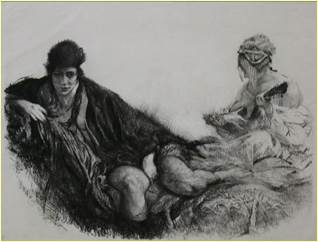
“Serenade” Etching by Paul Herrmann
Planographic Printing
Accidentally discovered in 1798 by
Based on the principal that oil and water are
repellents, the method requires the drawing of a design onto a heavy limestone
slab or litho plate with a grease pencil. The surface
is moistened with water and then rolled over with an oil based ink. This ink is
attracted to the grease-penciled design, whereas where the surface is damp and
clean, the ink is repelled. The stone is then covered with a sheet of paper and
run through a lithographic press, resulting in the image being transferred to the
paper.
Chromolithography simply means lithography in colours. To achieve this,
a series of carefully registered stones are used with an individual printing
for each colour, sometimes numbering more than thirty. Toulouse-Lautrec, Edvard Munch and Gaugin are a few artists noted for their
exceptional skill with this method.
The technique used in lithography permits an artist to
produce an astounding number of prints, though the stone is traditionally
re-polished in order to limit the edition size. Lithography should not be
confused with offset lithography, a publishing method based on photographic
processes.
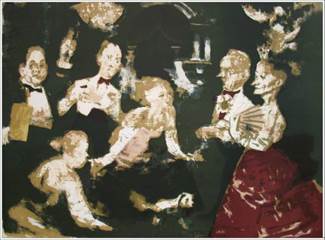
“Reception in Miami” Stone Lithograph by Jack Levine
Serigraph or Silkscreen
Not considered a fine art form until the 1930s, the
stencil based technique of silkscreen
actually originated in
Silkscreen
involves stretching porous fabric (such as silk) tightly over a frame and
painting areas of the fabric with a substance such as glue, creating a type of
stencil. Ink is then pressed with a squeegee through the unglued, remaining
portions of fabric onto paper beneath the screen. Several screens can be used
to achieve multi-coloured prints.
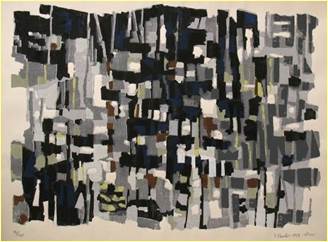
“Equilibrium” Serigraph by Jacov
Wexler
Collograph
The term collograph is derived from the Greek word collo, meaning glue, and graph meaning the occupation of drawing.
Collography is a printmaking process in which
materials are glued to a rigid surface such as cardboard or wood. The materials
used are as varied as the imagination allows.
Different tonal effects and vibrant colours can be
achieved through the depth of relief and the highly textured surface. When the
glued collage has dried it is ready to be inked using the artist’s choice of
method. Printing is accomplished with a press or by hand burnishing.
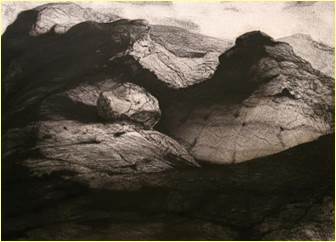
“Shadow Land” Collograph
by Michael Hames
Monotype
Monotype is a
one-off printmaking method in which a flat surface, such as glass, copper, or
zinc is painted with oil colours or ink and then passed through an etching
press. The technique allows for only one copy, or monotype. A wide variety of
materials from cardboard to perspex are used in the
creation of modern monotypes allowing artists to create veritable collages on
the surface, then printing with interesting and often surprising results.
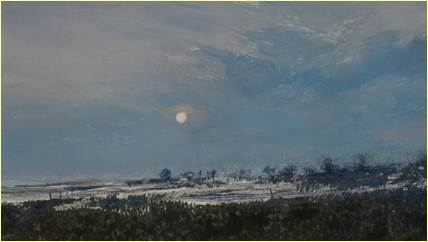
“Moon in
November” Monotype by Michael Hames
————————————————————————————————————————————————————
AVAILABLE ARTWORK GALLERY FOCUS ARTISTS’ PROFILES FINE
ART HOME
PICTURE FRAMING
CONTACT US HOME MICHAEL HAMES